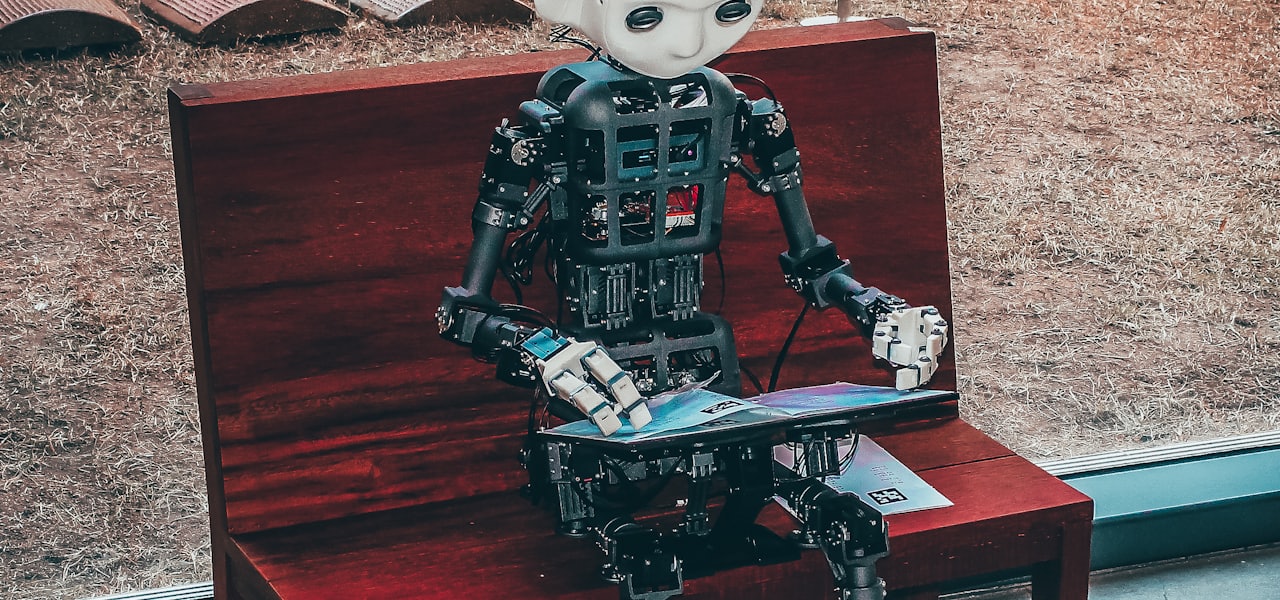
Curious about the best AI subtitle generator? An AI subtitle generator is software that uses machine learning to help you get more done — it combines speed, accuracy, and an interface that just works. Hands-on testing shows real-world results vary, so a short free trial is the smartest way to decide. Whether you are a beginner or a pro, the right AI subtitle generator slots into your workflow and pays for itself fast. Read on for hands-on impressions, pricing tiers, and the standout features that matter.
Artificial consciousness
Artificial consciousness, also known as machine consciousness, synthetic consciousness, or digital consciousness, is consciousness hypothesized to be possible for artificial intelligence. It is also the corresponding field of study, which draws insights from philosophy of mind, philosophy of artificial intelligence, cognitive science and neuroscience. The term "sentience" can be used when specifically designating ethical considerations stemming from a form of phenomenal consciousness (P-consciousness, or the ability to feel qualia). Since sentience involves the ability to experience ethically positive or negative (i.e., valenced) mental states, it may justify welfare concerns and legal protection, as with non-human animals. Some scholars believe that consciousness is generated by the interoperation of various parts of the brain; these mechanisms are labeled the neural correlates of consciousness (NCC). Some further believe that constructing a system (e.g., a computer system) that can emulate this NCC interoperation would result in a system that is conscious. Some scholars reject the possibility of non-biological conscious beings. == Philosophical views == As there are many hypothesized types of consciousness, there are many potential implementations of artificial consciousness. In the philosophical literature, perhaps the most common taxonomy of consciousness is into "access" and "phenomenal" variants. Access consciousness concerns those aspects of experience that can be apprehended, while phenomenal consciousness concerns those aspects of experience that seemingly cannot be apprehended, instead being characterized qualitatively in terms of "raw feels", "what it is like" or qualia. === Plausibility debate === Type-identity theorists and other skeptics hold the view that consciousness can be realized only in particular physical systems because consciousness has properties that necessarily depend on physical constitution. In his 2001 article "Artificial Consciousness: Utopia or Real Possibility," Giorgio Buttazzo says that a common objection to artificial consciousness is that, "Working in a fully automated mode, they [the computers] cannot exhibit creativity, unreprogrammation (which means can 'no longer be reprogrammed', from rethinking), emotions, or free will. A computer, like a washing machine, is a slave operated by its components." For other theorists (e.g., functionalists), who define mental states in terms of causal roles, any system that can instantiate the same pattern of causal roles, regardless of physical constitution, will instantiate the same mental states, including consciousness. ==== Thought experiments ==== David Chalmers proposed two thought experiments intending to demonstrate that "functionally isomorphic" systems (those with the same "fine-grained functional organization", i.e., the same information processing) will have qualitatively identical conscious experiences, regardless of whether they are based on biological neurons or digital hardware. The "fading qualia" is a reductio ad absurdum thought experiment. It involves replacing, one by one, the neurons of a brain with a functionally identical component, for example based on a silicon chip. Chalmers makes the hypothesis, knowing it in advance to be absurd, that "the qualia fade or disappear" when neurons are replaced one-by-one with identical silicon equivalents. Since the original neurons and their silicon counterparts are functionally identical, the brain's information processing should remain unchanged, and the subject's behaviour and introspective reports would stay exactly the same. Chalmers argues that this leads to an absurd conclusion: the subject would continue to report normal conscious experiences even as their actual qualia fade away. He concludes that the subject's qualia actually don't fade, and that the resulting robotic brain, once every neuron is replaced, would remain just as sentient as the original biological brain. Similarly, the "dancing qualia" thought experiment is another reductio ad absurdum argument. It supposes that two functionally isomorphic systems could have different perceptions (for instance, seeing the same object in different colors, like red and blue). It involves a switch that alternates between a chunk of brain that causes the perception of red, and a functionally isomorphic silicon chip, that causes the perception of blue. Since both perform the same function within the brain, the subject would not notice any change during the switch. Chalmers argues that this would be highly implausible if the qualia were truly switching between red and blue, hence the contradiction. Therefore, he concludes that the equivalent digital system would not only experience qualia, but it would perceive the same qualia as the biological system (e.g., seeing the same color). Greg Egan's short story Learning To Be Me (mentioned in §In fiction), illustrates how undetectable duplication of the brain and its functionality could be from a first-person perspective. Critics object that Chalmers' proposal begs the question in assuming that all mental properties and external connections are already sufficiently captured by abstract causal organization. Van Heuveln et al. argue that the dancing qualia argument contains an equivocation fallacy, conflating a "change in experience" between two systems with an "experience of change" within a single system. Mogensen argues that the fading qualia argument can be resisted by appealing to vagueness at the boundaries of consciousness and the holistic structure of conscious neural activity, which suggests consciousness may require specific biological substrates rather than being substrate-independent. Anil Seth argues that the complexity of brain neurons intrinsically matters in addition to their function and that it is not possible to replace any part of the brain with a perfect silicon equivalent. He points out that some of biological neurons exhibit activity aimed at cleaning up metabolic waste products, and writes that a perfect silicon replacement would require a silicon-based metabolism, but silicon is not suitable for creating such artificial metabolism. ==== In large language models ==== In 2022, Google engineer Blake Lemoine made a viral claim that Google's LaMDA chatbot was sentient. Lemoine supplied as evidence the chatbot's humanlike answers to many of his questions; however, the chatbot's behavior was judged by the scientific community as likely a consequence of mimicry, rather than machine sentience. Lemoine's claim was widely derided for being ridiculous. Moreover, attributing consciousness based solely on the basis of LLM outputs or the immersive experience created by an algorithm is considered a fallacy. However, while philosopher Nick Bostrom states that LaMDA is unlikely to be conscious, he additionally poses the question of "what grounds would a person have for being sure about it?" One would have to have access to unpublished information about LaMDA's architecture, and also would have to understand how consciousness works, and then figure out how to map the philosophy onto the machine: "(In the absence of these steps), it seems like one should be maybe a little bit uncertain. [...] there could well be other systems now, or in the relatively near future, that would start to satisfy the criteria." David Chalmers argued in 2023 that LLMs today display impressive conversational and general intelligence abilities, but are likely not conscious yet, as they lack some features that may be necessary, such as recurrent processing, a global workspace, and unified agency. Nonetheless, he considers that non-biological systems can be conscious, and suggested that future, extended models (LLM+s) incorporating these elements might eventually meet the criteria for consciousness, raising both profound scientific questions and significant ethical challenges. However, the view that consciousness can exist without biological phenomena is controversial and some reject it. Kristina Šekrst cautions that anthropomorphic terms such as "hallucination" can obscure important ontological differences between artificial and human cognition. While LLMs may produce human-like outputs, she argues that it does not justify ascribing mental states or consciousness to them. Instead, she advocates for an epistemological framework (such as reliabilism) that recognizes the distinct nature of AI knowledge production. She suggests that apparent understanding in LLMs may be a sophisticated form of AI hallucination. She also questions what would happen if an LLM were trained without any mention of consciousness. === Testing === Sentience is an inherently first-person phenomenon. Because of that, and due to the lack of an empirical definition of sentience, directly measuring it may be impossible. Although systems may display numerous behaviors correlated with sentience, determining whether a system is sentient is known as the hard pr
Natarajan dimension
In the theory of Probably Approximately Correct Machine Learning, the Natarajan dimension characterizes the complexity of learning a set of functions, generalizing from the Vapnik–Chervonenkis dimension for boolean functions to multi-class functions. Originally introduced as the Generalized Dimension by Natarajan, it was subsequently renamed the Natarajan Dimension by Haussler and Long. == Definition == Let H {\displaystyle H} be a set of functions from a set X {\displaystyle X} to a set Y {\displaystyle Y} . H {\displaystyle H} shatters a set C ⊂ X {\displaystyle C\subset X} if there exist two functions f 0 , f 1 ∈ H {\displaystyle f_{0},f_{1}\in H} such that For every x ∈ C , f 0 ( x ) ≠ f 1 ( x ) {\displaystyle x\in C,f_{0}(x)\neq f_{1}(x)} . For every B ⊂ C {\displaystyle B\subset C} , there exists a function h ∈ H {\displaystyle h\in H} such that for all x ∈ B , h ( x ) = f 0 ( x ) {\displaystyle x\in B,h(x)=f_{0}(x)} and for all x ∈ C − B , h ( x ) = f 1 ( x ) {\displaystyle x\in C-B,h(x)=f_{1}(x)} . The Natarajan dimension of H is the maximal cardinality of a set shattered by H {\displaystyle H} . It is easy to see that if | Y | = 2 {\displaystyle |Y|=2} , the Natarajan dimension collapses to the Vapnik–Chervonenkis dimension. Shalev-Shwartz and Ben-David present comprehensive material on multi-class learning and the Natarajan dimension, including uniform convergence and learnability. Recently, Cohen et al showed that the Natarajan dimension is the dominant term governing agnostic multi-class PAC learnability.
GNU Octave
GNU Octave is a scientific programming language for scientific computing and numerical computation. Among other things, Octave can be used to solve linear and nonlinear problems numerically and to perform other numerical experiments using a language that is mostly compatible with MATLAB. It may also be used as a batch-oriented language. As part of the GNU Project, it is free software under the terms of the GNU General Public License. == History == The project was conceived around 1988. At first it was intended to be a companion to a chemical reactor design course. Full development was started by John W. Eaton in 1992. The first alpha release dates back to 4 January 1993 and on 17 February 1994 version 1.0 was released. Version 9.2.0 was released on 7 June 2024. The program is named after Octave Levenspiel, a former professor of the principal author. Levenspiel was known for his ability to perform quick back-of-the-envelope calculations. == Development history == == Developments == In addition to use on desktops for personal scientific computing, Octave is used in academia and industry. For example, Octave was used on a massive parallel computer at Pittsburgh Supercomputing Center to find vulnerabilities related to guessing social security numbers. Acceleration with OpenCL or CUDA is also possible with use of GPUs. == Technical details == Octave is written in C++ using the C++ standard library. Octave uses an interpreter to execute the Octave scripting language. Octave is extensible using dynamically loadable modules. Octave interpreter has an OpenGL-based graphics engine to create plots, graphs and charts and to save or print them. Alternatively, gnuplot can be used for the same purpose. Octave includes a graphical user interface (GUI) in addition to the traditional command-line interface (CLI); see #User interfaces for details. == Octave, the language == The Octave language is an interpreted programming language. It is a structured programming language (similar to C) and supports many common C standard library functions, and also certain UNIX system calls and functions. However, it does not support passing arguments by reference although function arguments are copy-on-write to avoid unnecessary duplication. Octave programs consist of a list of function calls or a script. The syntax is matrix-based and provides various functions for matrix operations. It supports various data structures and allows object-oriented programming. Its syntax is very similar to MATLAB, and careful programming of a script will allow it to run on both Octave and MATLAB. Because Octave is made available under the GNU General Public License, it may be freely changed, copied and used. The program runs on Microsoft Windows and most Unix and Unix-like operating systems, including Linux, Android, and macOS. == Notable features == === Command and variable name completion === Typing a TAB character on the command line causes Octave to attempt to complete variable, function, and file names (similar to Bash's tab completion). Octave uses the text before the cursor as the initial portion of the name to complete. === Command history === When running interactively, Octave saves the commands typed in an internal buffer so that they can be recalled and edited. === Data structures === Octave includes a limited amount of support for organizing data in structures. In this example, we see a structure x with elements a, b, and c, (an integer, an array, and a string, respectively): === Short-circuit Boolean operators === Octave's && and || logical operators are evaluated in a short-circuit fashion (like the corresponding operators in the C language), in contrast to the element-by-element operators & and |. === Increment and decrement operators === Octave includes the C-like increment and decrement operators ++ and -- in both their prefix and postfix forms. Octave also does augmented assignment, e.g. x += 5. === Unwind-protect === Octave supports a limited form of exception handling modelled after the unwind_protect of Lisp. The general form of an unwind_protect block looks like this: As a general rule, GNU Octave recognizes as termination of a given block either the keyword end (which is compatible with the MATLAB language) or a more specific keyword endblock or, in some cases, end_block. As a consequence, an unwind_protect block can be terminated either with the keyword end_unwind_protect as in the example, or with the more portable keyword end. The cleanup part of the block is always executed. In case an exception is raised by the body part, cleanup is executed immediately before propagating the exception outside the block unwind_protect. GNU Octave also supports another form of exception handling (compatible with the MATLAB language): This latter form differs from an unwind_protect block in two ways. First, exception_handling is only executed when an exception is raised by body. Second, after the execution of exception_handling the exception is not propagated outside the block (unless a rethrow( lasterror ) statement is explicitly inserted within the exception_handling code). === Variable-length argument lists === Octave has a mechanism for handling functions that take an unspecified number of arguments without explicit upper limit. To specify a list of zero or more arguments, use the special argument varargin as the last (or only) argument in the list. varargin is a cell array containing all the input arguments. === Variable-length return lists === A function can be set up to return any number of values by using the special return value varargout. For example: === C++ integration === It is also possible to execute Octave code directly in a C++ program. For example, here is a code snippet for calling rand([10,1]): C and C++ code can be integrated into GNU Octave by creating oct files, or using the MATLAB compatible MEX files. == MATLAB compatibility == Octave has been built with MATLAB compatibility in mind, and shares many features with MATLAB: % Script: myscript.m a = 5; b = a 2 % Function: myfunc.m function result = myfunc(x) result = x^2 + 3; end Matrices as fundamental data type. Built-in support for complex numbers. Powerful built-in math functions and extensive function libraries. Extensibility in the form of user-defined functions. Octave treats incompatibility with MATLAB as a bug; therefore, it could be considered a software clone, which does not infringe software copyright as per Lotus v. Borland court case. MATLAB scripts from the MathWorks' FileExchange repository in principle are compatible with Octave. However, while they are often provided and uploaded by users under an Octave compatible and proper open source BSD license, the FileExchange Terms of use prohibit any usage beside MathWorks' proprietary MATLAB. === Syntax compatibility === There are a few purposeful, albeit minor, syntax additions Archived 2012-04-26 at the Wayback Machine: Comment lines can be prefixed with the # character as well as the % character; Various C-based operators ++, --, +=, =, /= are supported; Elements can be referenced without creating a new variable by cascaded indexing, e.g. [1:10](3); Strings can be defined with the double-quote " character as well as the single-quote ' character; When the variable type is single (a single-precision floating-point number), Octave calculates the "mean" in the single-domain (MATLAB in double-domain) which is faster but gives less accurate results; Blocks can also be terminated with more specific Control structure keywords, i.e., endif, endfor, endwhile, etc.; Functions can be defined within scripts and at the Octave prompt; Presence of a do-until loop (similar to do-while in C). === Function compatibility === Many, but not all, of the numerous MATLAB functions are available in GNU Octave, some of them accessible through packages in Octave Forge. The functions available as part of either core Octave or Forge packages are listed online Archived 2024-03-14 at the Wayback Machine. A list of unavailable functions is included in the Octave function __unimplemented.m__. Unimplemented functions are also listed under many Octave Forge packages in the Octave Wiki. When an unimplemented function is called the following error message is shown: == User interfaces == Octave comes with an official graphical user interface (GUI) and an integrated development environment (IDE) based on Qt. It has been available since Octave 3.8, and has become the default interface (over the command-line interface) with the release of Octave 4.0. It was well-received by an EDN contributor, who wrote "[Octave] now has a very workable GUI" in reviewing the then-new GUI in 2014. Several 3rd-party graphical front-ends have also been developed, like ToolboX for coding education. == GUI applications == With Octave code, the user can create GUI applications. See GUI Development (GNU Octave (version 7.1.0)). Below are some examples: Button, edit control, checkboxTextboxListbox wit
Operational taxonomic unit
An operational taxonomic unit (OTU) is an operational definition used to classify groups of closely related individuals. The term was originally introduced in 1963 by Robert R. Sokal and Peter H. A. Sneath in the context of numerical taxonomy, where an "operational taxonomic unit" is simply the group of organisms currently being studied. In this sense, an OTU is a pragmatic definition to group individuals by similarity, equivalent to but not necessarily in line with classical Linnaean taxonomy or modern evolutionary taxonomy. Nowadays, however, the term is commonly used in a different context and refers to clusters of (uncultivated or unknown) organisms, grouped by DNA sequence similarity of a specific taxonomic marker gene (originally coined as mOTU; molecular OTU). In other words, OTUs are pragmatic proxies for "species" at different taxonomic levels, in the absence of traditional systems of biological classification as are available for macroscopic organisms. For several years, OTUs have been the most commonly used units of diversity, especially when analysing small subunit 16S (for prokaryotes) or 18S rRNA (for eukaryotes) marker gene sequence datasets. == Molecular OTU by clustering of marker gene sequences == In the approach represented by DNA barcoding, a particular locus is chosen to be used as the marker gene for classification. This locus should be universally present in the scope selected, variable enough to be different among close-related species, and be flanked by conservative sequences that allow for easy amplification and detection. There are databases containing sequences for such marker genes from many different species, allowing for comparison. (Sometimes only using one locus does not provide sufficient resolution, so multiple marker genes are used. This is the case for plants, where rbcL+matK is common.) Sequences obtained this way can be clustered according to their similarity to one another, and operational taxonomic units are defined based on the similarity threshold set by the researcher. The exact threshold depends on the taxa in question and the mutational rates of the selected locus in the taxon. 97–99% are commonly used, but "it is now recognized to be somewhat arbitrary as sequence variation within and among species varies across taxa". 100% similarity (fully identical) is also common, also known as single variants. It remains debatable how well this commonly used method recapitulates true microbial species phylogeny or ecology. Although OTUs can be calculated differently when using different algorithms or thresholds, research by Schmidt et al. (2014) demonstrated that 16S-derived microbial OTUs were generally ecologically consistent across habitats and several clustering approaches. The number of OTUs defined may be inflated due to errors in DNA sequencing. === OTU clustering approaches === There are three main approaches to clustering OTUs: De novo, for which the clustering is based on similarities between sequencing reads. Closed-reference, for which the clustering is performed against a reference database of sequences. Open-reference, where clustering is first performed against a reference database of sequences, then any remaining sequences that could not be mapped to the reference are clustered de novo. Using a reference provides taxonomic context for the OTUs found. Alternatively, taxonomic context can be found after the construction of clusters by comparing representative sequences from clusters against a reference database. There are also specialized classifiers for this purpose which are much faster than naive comparison using BLAST. === OTU clustering algorithms === Hierarchical clustering algorithms (HCA): uclust & cd-hit & ESPRIT Bayesian clustering: CROP == Molecular OTU by other methods == In addition to similarity-based grouping, marker gene sequences can be sorted into OTUs using molecular phylogeny, k-mer composition, or hybrid methods combining these methods with similarity. There are also Bayesian tree-less methods and machine learning approaches. Using phylogeny often involves manually assigning terminal clades or single nodes to an OTU, so this is usually only done for refinement. Genome skimming can be used to obtain high-copy DNA without the need to choose marker genes or to design PCR primers for the chosen genes. It can provide fairly good coverage of organelle DNA and repetitive elements such as ribosomal DNA, both of which can be used like marker genes in OTU analysis. Whole-genome sequencing is more expensive and involves the production and processing of more data. By considering the entire genome, many (sometimes over 100) marker genes can be used at the same time, producing highly resolved phylogenies that correctly identify problematic taxa. It is also possible to use entire genomes for OTU assignment. For example, genomes from different bacterial species almost always have an average nucleotide identity lower than 95%, a fact that can be used to define new OTUs (and likely new species).
Universal psychometrics
Universal psychometrics encompasses psychometrics instruments that could measure the psychological properties of any intelligent agent. Up until the early 21st century, psychometrics relied heavily on psychological tests that require the subject to cooperate and answer questions, the most famous example being an intelligence test. Such methods are only applicable to the measurement of human psychological properties. As a result, some researchers have proposed the idea of universal psychometrics - they suggest developing testing methods that allow for the measurement of non-human entities' psychological properties. For example, it has been suggested that the Turing test is a form of universal psychometrics. This test involves having testers (without any foreknowledge) attempt to distinguish a human from a machine by interacting with both (while not being to see either individuals). It is supposed that if the machine is equally intelligent to a human, the testers will not be able to distinguish between the two, i.e., their guesses will not be better than chance. Thus, Turing test could measure the intelligence (a psychological variable) of an AI. Other instruments proposed for universal psychometrics include reinforcement learning and measuring the ability to predict complexity.
FERET (facial recognition technology)
The Facial Recognition Technology (FERET) program was a government-sponsored project that aimed to create a large, automatic face-recognition system for intelligence, security, and law enforcement purposes. The program began in 1993 under the combined leadership of Dr. Harry Wechsler at George Mason University (GMU) and Dr. Jonathon Phillips at the Army Research Laboratory (ARL) in Adelphi, Maryland and resulted in the development of the Facial Recognition Technology (FERET) database. The goal of the FERET program was to advance the field of face recognition technology by establishing a common database of facial imagery for researchers to use and setting a performance baseline for face-recognition algorithms. Potential areas where this face-recognition technology could be used include: Automated searching of mug books using surveillance photos Controlling access to restricted facilities or equipment Checking the credentials of personnel for background and security clearances Monitoring airports, border crossings, and secure manufacturing facilities for particular individuals Finding and logging multiple appearances of individuals over time in surveillance videos Verifying identities at ATM machines Searching photo ID records for fraud detection The FERET database has been used by more than 460 research groups and is currently managed by the National Institute of Standards and Technology (NIST). By 2017, the FERET database has been used to train artificial intelligence programs and computer vision algorithms to identify and sort faces. == History == The origin of facial recognition technology is largely attributed to Woodrow Wilson Bledsoe and his work in the 1960s, when he developed a system to identify faces from a database of thousands of photographs. The FERET program first began as a way to unify a large body of face-recognition technology research under a standard database. Before the program's inception, most researchers created their own facial imagery database that was attuned to their own specific area of study. These personal databases were small and usually consisted of images from less than 50 individuals. The only notable exceptions were the following: Alex Pentland’s database of around 7500 facial images at the Massachusetts Institute of Technology (MIT) Joseph Wilder's database of around 250 individuals at Rutgers University Christoph von der Malsburg’s database of around 100 facial images at the University of Southern California (USC) The lack of a common database made it difficult to compare the results of face recognition studies in the scientific literature because each report involved different assumptions, scoring methods, and images. Most of the papers that were published did not use images from a common database nor follow a standard testing protocol. As a result, researchers were unable to make informed comparisons between the performances of different face-recognition algorithms. In September 1993, the FERET program was spearheaded by Dr. Harry Wechsler and Dr. Jonathon Phillips under the sponsorship of the U.S. Department of Defense Counterdrug Technology Development Program through DARPA with ARL serving as technical agent. === Phase I === The first facial images for the FERET database were collected from August 1993 to December 1994, a time period known as Phase I. The pictures were initially taken with a 35-mm camera at both GMU and ARL facilities, and the same physical setup was used in each photography session to keep the images consistent. For each individual, the pictures were taken in sets, including two frontal views, a right and left profile, a right and left quarter profile, a right and left half profile, and sometimes at five extra locations. Therefore, a set of images consisted of 5 to 11 images per person. At the end of Phase I, the FERET database had collected 673 sets of images, resulting in over 5000 total images. At the end of Phase I, five organizations were given the opportunity to test their face-recognition algorithm on the newly created FERET database in order to compare how they performed against each other. There five principal investigators were: MIT, led by Alex Pentland Rutgers University, led by Joseph Wilder The Analytic Science Company (TASC), led by Gale Gordon The University of Illinois at Chicago (UIC) and the University of Illinois at Urbana-Champaign, led by Lewis Sadler and Thomas Huang USC, led by Christoph von der Malsburg During this evaluation, three different automatic tests were given to the principal investigators without human intervention: The large gallery test, which served to baseline how algorithms performed against a database when it has not been properly tuned. The false-alarm test, which tested how well the algorithm monitored an airport for suspected terrorists. The rotation test, which measured how well the algorithm performed when the images of an individual in the gallery had different poses compared to those in the probe set. For most of the test trials, the algorithms developed by USC and MIT managed to outperform the other three algorithms for the Phase I evaluation. === Phase II === Phase II began after Phase I, and during this time, the FERET database acquired more sets of facial images. By the start of the Phase II evaluation in March 1995, the database contained 1109 sets of images for a total of 8525 images of 884 individuals. During the second evaluation, the same algorithms from the Phase I evaluation were given a single test. However, the database now contained significantly more duplicate images (463, compared to the previous 60), making the test more challenging. === Phase III === Afterwards, the FERET program entered Phase III where another 456 sets of facial images were added to the database. The Phase III evaluation, which took place in September 1996, aimed to not only gauge the progress of the algorithms since the Phase I assessment but also identify the strengths and weaknesses of each algorithm and determine future objectives for research. By the end of 1996, the FERET database had accumulated a total of 14,126 facial images pertaining to 1199 different individuals as well as 365 duplicate sets of images. As a result of the FERET program, researchers were able to establish a common baseline for comparing different face-recognition algorithms and create a large standard database of facial images that is open for research. In 2003, DARPA released a high-resolution, 24-bit color version of the images in the FERET database (existing reference).